Showing posts with label Sales Cycles. Show all posts

November 04, 2009

How to Find Out What Buyers Really Want

Here is a statement of the obvious: buyers don’t buy products, or services they buy solutions to problems, or the ability to exploit opportunities. In short they buy them to meet a need. So, why do sellers spend 9 times more time talking about their solutions than the needs of the buyer?

Before a buyer buys he, or she must have a need and that need must have a certain urgency, or priority. If the seller wants to sell his, or her solutions then he, or she must clearly demonstrate how it can solve the buyer’s problem. The problem is that listing product features and benefits is an ineffective way of doing this.

To remedy this problem here is a checklist to guide you in identifying and then meeting the needs of the buyer.:

1. Avoid premature diagnosis of the solution. In other words he, or she must define the problem before prescribing a solution. Don’t make assumptions regarding the customer’s needs, or assume that he, or she needs what you are offering. Ask first and give the customer a chance to say no.

2. The expert may immediately know the problem and perhaps even the solution. However, he, or she must take care to involve the customer in the discovery and build trust along the way. Connecting with buyer’s needs, requires a consultative approach with the salesperson adopting the role of an expert, or trusted advisor.

3. Understand what stage the buyers is at:
- The need is hidden (blissful ignorance)
- The need is recognized
- They are actively looking to resolve the need.

4. Understand the company and its industry, as well as its goals and strategy. Without this the seller will struggle to understand what is motivating the buyer. Understand the tradeoffs, constraints and complicating factors that bear on the needs. Understand needs from the perspective of the different stakeholders.

5. Don’t take the buyers needs on face value. Dig beneath the surface. Look to the implications of the needs. Help the buyer to develop a clearer picture of his/her needs and the advantages of solving them.

6. More questions are not the answer. Ask better questions – those that relate to needs and their implications. Don’t ask situational questions – for example about the size of the company, how long it was established – that is information that is ‘nice to know’ as opposed to ‘need to know’, or can be found from other sources (such as the company’s web site).

7. Buyers can be slow to open up. When they hear questions they fear closing. So the seller must earn the right to ask questions. This is done by showing tact, a willingness and ability to help.

8. Be tactful and sensitive regarding how they unearth the buyer’s needs. Protect the person when identifying the problem and don’t make the buyer feel like a fool!

9. It is not enough just to listen and to understand needs, but to provoke, inspire, enthuse and engage with the seller around the opportunities and challenge facing its business.

10. The sales person must help the buyer envision life after the problem has been solved. No pain, no sale - that was the old sales philosophy, with the job of the salesperson being to find and accentuate points of pain. However, the sales pro moves beyond the pain and the problem to focus on the benefits, the vision, the business impact and the likely risks that will need to be overcome.

11. Sell to those with latent needs. The role of the salesperson now includes demand generation. That means traditional prequalification criteria no longer apply.

12. Selling higher in the organization – where priorities are set and budgets can be set in response to the identification of needs. This will require a new vocabulary and a new message. It also requires confidence and skill.

Questions About Needs:

So with those tips in mind here are some questions to help you address the buyer's needs:
- What does the buyer want to achieve?
- What does the company want to achieve?
- What are the key business drivers in this area?
- What is the underlying opportunity, or challenge facing the business? How big is it? How urgent is it?
- What is the gap between desired and actual performance in the area in question? - How does this compare with internal and external expectations?
- What are the relevant industry drivers, or trends?
- Are there any critical events, or dates?
- Who does it impact on most? How? Who else is affected? In what ways? What are the consequences? What is the cost?
- The impact on the business - has it been quantified? What are the benefits of its resolution? Are they quantified in a credible manner?
- What are the relevant metrics? How will success be measured?
- Is this area a priority? If it is why has it not been addressed to date (constraints)?
- Has the issue been address/discussed in the past? What happened as a result?
- What are the competing priorities and projects?
- How does it fit with existing people and processes?
- What are the barriers to addressing the need / exploiting the opportunity?
- What could prevent it? What constraints?
- What is the context in terms of the organisations history, culture, politics, etc?

Why Sales People Are 9 Time More Likely to Talk About Themselves!

From our experience watching hundreds of sales presentations, pitches and proposals sellers spend 9 times as much time talking about themselves (that is their companies and solutions), as they do about the buyer’s needs. It should be the other way around and if it was, we believe, it could double, or triple the rate of success of the average salesperson.

So, how do you know where the sales person is focused? Well, listen out for the words that are used in sales pitches, presentations and proposals.

Focused on Needs

Focused Elsewhere

Using these words means you are
focused on the buyer’s needs:


Challenges / Needs
Problems / Opportunities
Goals / Objectives
Strategies
Priorities
Performance Gaps
Metrics
Results
Impact
Risk


Using these words suggests you are
focused on your solution:


Competitive advantage
Benefits
Features
Technology
Unique Selling Point
Value Proposition
Our company, People, Skills, Capabilities, etc.
Our Services, Products, or Systems
‘industry leading’, ‘best in class’, ‘innovative’, etc.
Price


To understand this better we have been considering the following questions:
  • What is so difficult about finding out about the buyer’s needs before arriving at a solution?
  • Why do sellers feel that they have to convince the buyer that they have the best solution before they have found out what the buyer’s problem is?
Well here are some possible answers:
  • The buyer is reluctant to reveal his, or her problem to the seller.
  • The buyer says he, or she knows what is wanted and the seller accepts that this is true.
  • The salesperson has been trained to talk features and benefits.
  • The seller believes that his, or her solution is the best regardless of the specific needs of the customer.
  • The seller assumes he, or she knows what the customer wants, so there is no need to discuss it.
  • The sales person does not have the knowledge, or skill to be able to uncover the buyer’s needs.
  • The problem is so obvious to the salesperson that getting straight to the solution makes sense.
  • Sellers are used to selling to lower level managers, where discussions around features and technologies, can be welcomed. At senior levels they are not
  • The seller assumes that the buyer can join the dots and link the solution to his, or her problem.
  • Time with the buyer is limited so communicating key product information is a priority.
All of these are factors.

The Access Rules

Access to all those stakeholders in the buying decision is a privilege, not a right and if you are fortunate enough to get it, here are the rules you must follow:

  1. Always obey the rules regarding access, don’t go over or around others to get to who you want
  2. In order to ensure you access the right people, map the buying process to the organisational chart to identify you need to meet. Then pair it with your team as appropriate (e.g. CFO to your CFO).
  3. Tell them why you want to meet, ask them what they want to get from it and set a clear agenda in advance.
  4. Take advantage of other forumn for interacting with those managers of interest, for example, industry association events, conferences, etc.
  5. Use access sparingly and plan it to get the most from any time you have with stakeholders. That includes meeting at the right time and when the objectives or value of doing is at its most. For example, make sure you have your initial briefing, or scoping completed first.
  6. Do your homework in advance, make sure you are fully prepared (e.g. don’t waste time gathering information in the meeting that you could have found from the company’s website, or annual report).
  7. Research person you are going to meet, to understand their role, their previous positions, their qualification, any contacts that you have in common, etc.
  8. Consider the use of workshops that have a value to the buyer as a means of making access efficient. For example a workshop on defining requirements, completing the business case, etc.
  9. Make sure meetings and presentations don’t go on for longer than they have to.
  10. Provide the buyer with useful insights, or information to aid the decision making process.
  11. Provide tools and templates that can support eliciting requirements, defining the specification, building the business case and making the business decision.
  12. Be judicious and tactful regarding the questions you ask of the buyer, remember you have to earn the right to ask questions that are invasive, or sensitive.
  13. Always get permission to include them in your marketing in the future.
  14. Always make a point of expressing your gratitude for the time you have been granted by the buyer.
  15. Send a note with a summary of the meeting and some useful piece of follow-up material, or information for the buyer.
  16. Keep your main sponsor, or contact in the loop regarding any meetings you have with his, or her colleagues.


September 17, 2009

Revolutionary Ideas: To Speed Up The Sale You Must Slow Down

Longer Buying Cycles Mean Sales People Must Slow Down.

Shortening sales cycles is something that managers dream about. But in most cases, it is just that – a dream. Yes, longer sales cycles have implications for meeting sales targets and sales costs, as well as for the overall level of visibility, predictability and control in respect of sales.


However, the reality is that regardless of lengthening sales cycles, a slower sale, is better than a lost sale. So here is another revolutionary idea - you need to speed up the sale, you may need to slow down.


To Speed Up, You May Need to Slow Down.

Salespeople often rush between appointments, skillfully avoiding the congestion bottlenecks and finding all the short cuts. They like to drive, talk and sell faster - it is all part of our genetic make-up! However, as buyers have put on the brakes salespeople who can’t, or won’t slow down to the new pace at which buyers are making buying decisions will look in the rear view mirror and find that the prospect is nowhere to be seen.


There was a time when you could prequalify over the phone and close in the first sales meeting. But no longer! It is going to take many calls and many meetings to get to the starting line, not to talk about the finishing point.


To improve win rates in a tough market, sellers have to revisit the timing on their sales pipeline and adjust the timing of their ‘conveyor-like’ sales processes. Specifically, they have to slow down in the following 10 ways:


1. Slowdown before you diagnose the solution – you have seen the situation 100s of times and can clearly see the problem, but slow down so as to ensure that you understand all the nuances, as well as the political and organizational context

2. Slow down before prequalifying – in a market of buoyant demand salespeople were eager to prequalify early so that they could spend their limited time with those who represented the greatest prospect of a sales. Market conditions have changed however and that means selling to those who have a budget is not enough. For every customer who is ready to buy, there are 8, or 9 that have the potential to buy but are not. They may not even be aware that they have a problem and so replacing prequalification that identifies those ready to buy, with marketing that nurtures those who can and perhaps should buy, but are not ready, is key.

3. Slow down in your first meeting – too many sales people are still aiming for the one meeting prequalification and even one meeting close. However, those salespeople are being increasingly boycotted by buyers who want to go at their own pace. That is because for buyers it feels too much like being sold to. Increasingly salespeople are realizing that you cannot understand a buyer, his needs, or his business in one meeting, just as you cannot build a relationship, or establish trust in that 45 minute time frame.

4. Slow down before proposing a solution – take time to understand the buyer’s full needs, to jointly explore solutions, to build rapport, etc.

5. Slow down before asking too many questions, particularly invasive ones – you have to earn the right to ask questions, especially sensitive ones. You have to be willing to share information with the buyer, before he, or she will return the favor.

6. Slow down before delivering a presentation - take the time to first understand the needs and interests of your audience, put the laptop and the presentation slides aside and have a conversation – see where it takes you.

7. Slow down before writing a proposal, the faster you write a proposal the more assumptions you are going to be making regarding the customer’s needs and wants. Getting the customer involved in writing the proposal with you may mean that you have to move the opportunity out by a quarter, but dramatically increases the likelihood of success.

8. Slow down before starting to negotiate – good negotiating cannot compensate for bad selling. Negotiating on price, for example, before the needs have been fully understood, the solution defined, or the business case demonstrated is meaningless and inadequate.

9. Slow down before moving on to your next customer – buyers often complain that the attention – sometimes excessive – that they have received during the sales process quickly diminished once the order is won.

10. Slow down when you see a red, or amber light - as salespeople focused on getting the deal across the line, we can be reluctant to express their concerns, or anxieties, regards an opportunity in play. We can be blind to warning signs, such as we cannot get access to the decision maker(s), we don't have all the information we need, the issue of price is arising too early, etc. However, they are to be neglected at our perril. Yellow and red flags are to be welcomed, this is particularly the case when they are indentified early in the sales cycle – that is in time for the underlying issues to be addressed, or for the salesperson to decide to walk away.


September 02, 2009

10 Questions Than Reveal What You Must Do To Win The Sale

The professional salesperson is a student of buying. This is particularly important at a time when buying decisions have become increasingly complex. The success of a deal depends on understanding now only how the buying decision will be made, but also the business decision that so often underlies it.

With this in mind we have put together 10 of the most important questions that salespeople need to answer in respect of each opportunity in their pipeline. Answering these questions and considering the implications of each has the potential to significantly increase your chances of success.

Questions To be Asked
Implications To be Considered
1. Who are all the stakeholders?
Do we understand the requirements of all stakeholders, not just technical, for example? How can we ensure access, without by-passing agreed channels?
2. Who are all the decision makers & influencers?
Have we had contact with all the decision makers? Do we understand their personal, as well as business drivers? How are we positioned with each?
3. Is there a clear definition of requirements?
Is the requirements definition clear? How has it been gathered? Is it complete – are there needs that we can additionally address? Has it been validated? Have requirements been prioritized, with any contradictions and tradeoffs addressed? Is the weighting of requirements reflect our strengths and minimize our weaknesses, or can be influence it to do so?
4. What is the buying process? What are the key steps? How long will it take?
How sophisticated is the buying process? What stage is the prospect at now:
·Recognition of need?
· Search for a solution?
· Selection of supplier?
5. What about competing projects (that includes ‘do it in-house’)?
Are there competing projects for the same budget? Could the project be delivered in-house? Could the project be delayed till next quarter, or next year? What factors will determine the selection of these options?
6. Is a business case required? What format will it take? Who will write it?
Can we provide information that will help build the business case, in terms of:
Costs?
Benefits?
Risk? (including implementation)
That includes a model to create quantify benefits and total cost of ownership.
7. What is the role of procurement?
Have we had contact with procurement? Do we understand their requirements?
8. Is there a shortlist of vendors? How many? What is the criterion?
How do we rate on the shortlist criteria? Can we help shape the criterion?
9. At what level is final sign-off required?
If this requires board level sign-off for example – how will this impact on selection? How does our proposal connect with strategy? Has our proposition being CEO proofed? Can we have access to / inform board members in advance of the decision?
10. Who is in the role of business analyst – that is the bridge between technical and business – whose role it is to create the business case?
Who has this responsibility? If there is no person (for example the IT director is creating the business case) then this raises issues regarding how the proposal will be reviewed at board level, for example.
So, for each opportunity in your pipeline, ask each of the questions outlined above, considering the implications of your answers for your next steps in managing that opportunity to the point of closing.

August 26, 2009

Why Sales People Should Think in Terms of Buying Cycles

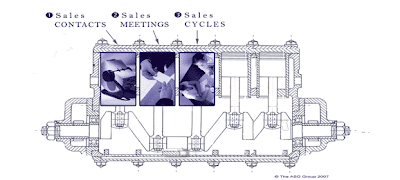
A cycle is defined as 'a series of events that are regularly repeated in the same order'. Thus the term fits well with the modern world of buying and selling, with buyer and seller increasingly adopting a structured and systematic approach to their work. In this article we discuss the many reasons why we have used the term cycle as part of the sales and marketing engine (shown below).

Don’t miss the cycle. If you go straight from sales meeting to sales proposal, you miss a vital step. That is the essential step where you confirm, clarify and shape needs, establish the requirements of stakeholders, explore solutions and gain a shared commitment to take action. It is where you sell your solution, people and processes. 

Don’t sell too early, because:
· Selling in initial sales meetings or in cold calls is ineffective. Buyers don’t like it. You have to use a more effective means of getting their attention. Simply delivering your traditional, feature led, sales pitch will not work.
· A proposal written without sufficient interaction with the prospect runs the risk of failing to accurately understand needs, or to build ownership of the solution among the prospect.
· You cannot sell until you know what is required. Even if you already know, you cannot sell until you show you are interested.
· You cannot fast track the buying decision, or the building of a relationship.

Buying decisions are complex, indeed increasingly so. Cycles connotates this well. There are many people involved in the buying decision, multiple stakeholders, complex requirements (some of which may be conflicting), competing priorities and projects.

Buying cycles do not necessary correspond with sales cycles. Buyers call sales people to the table later and later, often after requirements have been determined and the business case created. To avoid this sellers have to look beyond those who have a need and a budget, that means selling to satisfied.

Buyers don’t just arrive at decisions; they go through a process of decision making. We look at organisations who are at 3 stages:
· Recognition of need
· Search for solution
· Selection of supplier

The salespeople must think in terms of the buying cycle. The sales approach should vary depending on the stage the buyer is at. The sales approach has to blend each stage. For example, if a prospect is looking for training it is beneficial to look beyond that solution to the need – that is what the training is expected to achieve. This examination may enable the ideal training solution to be defined, or indeed enable looking beyond training to other solutions.

A structured sales process is important. We wanted a term that related to a sales process, as well as buying process. This is important for two reasons firstly it helps with pipeline visibility, predictability and control. Secondly it helps to determine if an opportunity has proceeded though the standard steps of the sales process, for example;
· needs analysis across all stakeholders,
· defining buying requirements,
· covering the buying unit,
· prequalification of the opportunity (in terms of budget, timing, etc.).

Selling is complex. We wanted a term that recognized that sales process is not a straight line. The salesperson may at certain times feel like good progress is being made, while at other times he or she may feel that the deal is getting further away, as opposed to closer.


Buyer trumps seller, every time. We wanted to focus attention on buying process, as opposed to sales process – but not just about trying to corral the buyer into a process that suits the sales organization. Indeed, often the seller is not at the centre of the buying process.
Avoiding confusion. We could have called this cylinder opportunities, or prospects. Here is why we didn’t:
· Both terms are hard to define and can be highly subjective
· Both terms tend to suggest that you can go straight into a pipeline forecast after a meeting or two
· we wanted a term that was buyer – seller neutral –that is relevant to either side

Your work is never done, until the decision is made the salesperson must continue to build the relationship, understand the needs and so on. If the seller stops then he may be leaving the way open for a competitor.

The sale is not the end. The cycle in a way, has no beginning and no end. The relationship is more important than the order, or the transaction. Even if vendor does not win one order, it does not mean that the relationship should not be maintained. The lifetime value of the relationship is what is important. Suppliers disappoint their customers all the time, so by maintaining the relationship, in spite of not winning the order, the salesperson can ensure that he, or she is in pole position for the next purchase.

Both sides now! We also like the term cycle because it fits well with what we call 360 degree selling –where the salesperson is able to make a 360 degree wing from the sellers side of the table to the buyers side of the table and back again - thereby facilitating a better understanding of the buyer’s requirements and capable of adopting the position of trusted advisor. This is also reflective of a bi-lateral approach to the sale, where buyer and seller engage in a joint process of exploration and problem solving. This is particularly important in an environment where buyers are increasingly keeping salespeople at arm’s length.
Bi-Cycle or uni-cycle. We like to think of cycles (either buyer, or seller) as being two types, that is; bi cycle, or uni cycle. The later involves the salesperson, or buyer alone, while the former involves both in equal partnership. Two wheels are better than one - it is what others have called Joint Venture selling, or a bi-partisan approach.
For an overview of the sales engine and its role in setting sales and marketing priorities click here.

August 13, 2009

Want to Build Trust? Then Minimise Buyer Risk

Finding the issue of trust a little difficult to deal with? Well, look at it in terms of the buyer’s risk can help. Specifically the risk of making the wrong buying decision and the consequences in terms of; embarrassment, annoyance and cost. Your concern for and efforts to reduce the buyer’s risk are probably the most effective way to build trust.

Is Trust a Little ‘Airy Fairy’?

A lot has been written about trust based selling, to which we have added more than a few lines. I have to confess however, that like many people, I find it a little strange to talk about the subject.

Let’s face it talking about the buying process and the business case is a lot easier. Trust can be hard to define and hard to measure.

Buyer risk of course is the real issue. That is why trust is important and necessary. Buyers are not guaranteed the outcomes that they require because of a range of business, technical, project/delivery and supplier related risks.

Minimizing Buyer Risk.

The buyer’s job is to minimize those risks. That means the buying decisions is not just about costs and benefits – factors that are somewhat easier to measure. It is also about the likelihood of those costs and benefits and any other consequences that may arise.

There is also the personal risk inherent in the decision itself that is of; being compromised, bypassed, or undermined. That includes the information that is provided, the choice of suppliers that are engaged, the level of openness and engagement with selected vendors.

It is unfair, but as salespeople are remembered for the big deal, buyers are remembered for the bad ones. That means a life of successful purchases could be overshadowed by one mistake, or one miscalculation of risk.

Building Buyer Confidence.

As regards trusting the seller, the buyer has to be confident that the organization will deliver what is promised, do it well, pick up the pieces if anything goes wrong and look out for your personal, team and organizational best interests along the way. Of course, he, or she has to trust the salesperson making the promises, the team that will deliver and the organization that is backing it all up. These are inseparable.

Trust is not the default setting as regards business relationships and particularly buyer-seller relationships. It has to be built up over time. With many cynical buyers trust may not even be possible. However, that does not mean that the salesperson should not work towards the attainment of this idealized ‘trusted advisor’ position. Like Buddhists, for example, not all will achieve the highest states of meditative bliss, however that does not stop them working towards its attainment.

While the buyer won’t buy if he, or she does not trust the seller, nor will he or she buy if key requirements (value for money, compliance, business impact) aren't clearly met. Trust alone won’t swing it. Let us be clear about it ‘trust’ is only part of the equation. The buyer’s business case has another word for it - that is risk.

How does the salesperson and the sales approach minimise buyer risk? Well it counts right across the sales cycle, for example:

· Replace marketing brochures, with insightful white papers

· Develop customer case studies and effectively use customer testimonials

· Develop the position as a thought leader

· Provide access to your experts

· Allow your prospect to experience your services/products during the sales cycle

· Employ effective pilots and demos

· Understand the buyers requirements before advocating a solution

· Don’t try to impose your sales process on the buyer

· Earn the right to ask questions and employ tact when you raise sensitive issues

· Focus on helping, not selling

· Focus on the business case

· Show your commitment to the prospect

· Demonstrate professionalism and respect at every turn (keeping promises, turning up on time, keeping notes of meetings, listening & showing a personal interest)

· Follow the rules of engagement and access

· Share information with the buyer

· Don’t tell stories that suggest you are breaching the trust of other customers.

· Answer direct questions with direct answers

Building trust takes time, trusted relationships do exist between buyers and seller. These relationships can be built by small, medium and large scale enterprises selling high value services and solutions. According to one professional buyer "trust helps buyers buy and sellers sell, it minimizes risk on both sides. Without trust you have dysfunctional buying and selling which helps know one".

August 11, 2009

The Rise and Rise of the Business Case - A Review of Best Practice


Many large organizations require a business case for purchases of as little as €20,000. Unless the seller's proposal focuses on costs, benefits and risks it is going to miss the mark.


The Rise of the Business Case.

As one salesperson told us recently; ‘I have seen more business cases in the past year than I have in the previous 19 years’.

With budgets being squeezed, projects and purchases must increasingly compete for scarce organizational resources. The reality is the business case is now more important than the sales proposal.

The Salesperson as Business Case Facilitator.

The emergence of the business case as the prime factor in organizational spend decisions obviously presents advantages for those sellers who can demonstrate the business justification for their solution.


If a vendor wants to win the sale, they must at least input to the preparation of a credible and compelling business case. Traditional features and benefits message are no longer adequate.

What your solution does and how it does it, including the technology involved, is the stuff of traditional sales presentations, but not a business cases.

The reality is that many buying decisions are made when the salesperson is not in the room, by a sceptical audience that the sales person may not have met, based on information which the salesperson has had little, if any input to. Traditional feature led sales pitches are out of touch and won't cut it in the boardroom.

The Compelling Business Case.

Whether your sales goes ahead will depend on a ‘to the point’ value equation, that reflects not only costs, benefits and risk, but also how the project will contribute to the achievement of broader organizational goals and strategies. That is the new reality of the business case sale.


A compelling business case is not just important in getting the sale, it is also essential to ensuring successful implementation and developing long term client relationship. As one buyer said to us, "the business case is also playing a role in guiding, tracking and managing project success, it may no have done in the past but it is now".

A Review of Business Case Best Practice.

In order to guide you in your new role as business case facilitator to your prospect we have reviewed the work of 9 of the leading experts in this space (the list is at the end.)


Specifically, this article presents an overview of the key advice from specialist books written for buyers on how to develop a business case and sell their projects internally.

The Business Case and Success.


The business case is not just a means of optimizing the allocation of scare organisational resources among competing projects. It is also an important means of ensuring project, as well as organisational success.

Let us take IT projects as an example. Everybody knows that most IT projects run into problems - the Standish Group and other figures are familiar to us all. However, the cause of those problems is often misdiagnosed.


Indeed, most of the experts suggest that the number one reason for the failure of IT projects is a poor business case, or no business case at all. That is not just failures in terms of delivering on time and within budget, but more fundamentally for IT to impact on business success.

Cost overruns are often not the result of overspending, but of underestimation of costs at the planning and budgeting stage. Indeed, the problems with most projects can be traced back to their inception and planning. The business case has an important role to play in making sure projects get started, but also stay on track.

Business Case Quality Issues.

Some of the experts suggest that expenses claims were subjected to more scrutiny than business cases for the purchase of multi-million pound IT systems!

All too often the business case was seen as bureaucratic, as opposed to a strategic exercise. As a result, many business cases were prepared to justify a desired choice of action, as opposed to presenting management with the information required to evaluate, select, manage and track projects in terms of their impact on the organizational success. Times have changed whether it is an external purchase, or an in-house solution, the development of a robust business case is now essential. As sales people we need to ensure we keep our focus on the how (the features, the technology, the solution) and the why (the business case).

12 Tell tale Signs of Poor Business Cases

Based on our experiences and the experiences of nine leading experts in the field, here are 12 telltale signs of poor business cases:

1. Lack of skills, discipline, or more importantly objectivity
2. Absence of cross functional involvement
3. Failure to engage with stakeholders and their needs, creating buy-in in the process
4. Failure to adequately define scope and requirements
5. Failure to present a menu of alternatives and options, in the context of business drivers and constraints
6. Lack of feasibility study type information and scientific validation, or data
7. Failure to address how the project fits with the organization’s strategy and past decisions.

8. Failure to conduct an accurate, robust, and credible cost – benefit analysis, underscored by clear and realistic assumptions
9. An overly simplistic analysis of project related risk, or implementation issues (governance, control.)
10. An overly simple view: The business case is prepared and presented; but it has limited value throughout the project lifecycle
11. Lacks structure and process for completion / agreement
12. Weak investment analysis

Business Case - Document, or Process?

Underpinning many of these problems is the fact that the business case is often seen as a document, rather than a process. This is particularly the case in the absence of corporate standards with regard to:
· How a business case should be completed
· What it should contain
· Who should be involved
· How it will be evaluated
· What templates are to be followed

The single most important factor in terms of business case preparation is the process involved, in that any business case is only as good as the process by which it is prepared. Also the process of business case preparation is iterative, evolving to reflect changing needs and requirements.


The Full Life cycle Business Case.

All too often a business case document is hastily prepared and then once the project is given the green light it is put aside. A business case should be a living document, that:

· Guides implementation
· Tracks progress
· Manages change requirements and helps the seller and buyer
· Enables management to assess if projects are delivering as expected and if corrective action is required


Business Case - Attractiveness and Achieveability.

A business case is concerned with 2 dimensions of a project – attractiveness and achievability. So it is not enough to include just a cost and benefits justification.

The business case must also address how achievable it is, including for example a register of risk, as well as details of implementation, governance and control.

When it comes to the economic analysis, it is important to realize that people often have a genuine difficulty with numbers and in particular in working with spreadsheets. That is not withstanding the challenge that may be presented in terms of the monetization of benefits, particularly in the case of less tangible ones.

All of the above is a lot to take in, as sales people we need to develop our business case development skills.

How To Get the Prospect To Do Your Prequalification for You

How you allocate your time as a salesperson is key. In particular, maintaining a healthy pipeline requires that you balance your efforts as follows:
- Focusing on closing the most likely deals for this quarter
- Nurturing those prospects with potential for next quarter
- Generating fresh leads to go in at the top of the sales funnel.

To get the balance right can be a challenge.  Key to the efficient use of time is a system for prequalifying those prospects and opportunities on which you are going to focus.  However that is not all you are going to need - because prequalification is too often applied in a blunt manner.

Prequalifying Leads.

With the effort that is required to generate leads, your sales and marketing efforts must be aimed as precisely as possible at those companies - and only those companies - that fit your ideal target customer profile.  Beyond that you need to be careful.

The popular BANT (budget, authority, timing and need) criteria applied too rigorously, for example on the basis of an inbound enquiry, or cold call, could exclude the bulk of the marketplace, including many companies that, don't presently have a budget for your solution, but could represent potential customers.  There are two reasons for this.

The first is that buyers are reticent about sharing information with a salesperson that they don’t know. So, the reality is that any prequalification questions will only elicit superficial answers at the early stages of contact.

Imagine, for example, a salesperson you don’t know calls out of the blue and asks:
- ‘Do you have a budget for replacing front end systems this year?’ Your immediate reaction is ‘that is sensitive information how do I know where it will end up’.
- ‘Who has decision making responsibility for purchases in this area?’ Your thoughts might include; ‘you don’t want to talk to me because you don’t think I am important enough!’, or ‘I am not going to give you a name so that you can ring up and pester them – thereby getting me in trouble!’

The second reason is that you cannot limit your sales and marketing activity to those that have a budget, a well as an immediate and pressing need. That is because those that are ready to buy are but the tip of the iceberg in terms of the potential for your product.

Indeed those ready to buy are likely to be greatly out numbered by those who have the potential to buy in the future, but are as of yet unaware of your solution, or perhaps even unaware of the need for your solution.

Replacing Pre-qualification with Marketing.

Bottom line, the sales organization must generate, or at least foster and nurture demand for its solutions, while at the same time selling to those who are already actively searching for a solution in the marketplace. That means sales and marketing must work together marketing.

When this happens marketing effectively substitutes for prequalification at the lead generation stage.  While some leads are classified as sales, or sales meeting ready, those that are not ready for the next step are not, as is often the case, left to waste.

The balance of leads while not sales read are marketing ready and can stay in the pot for further nurturing by means of the occasional email with a link to a white paper, an invitation to an event, or webinar, the occasional telephone call and so on.

Pre-qualificaiton of Sales Opportunities.

What about later in the sales cycle?  Well, prequalification becomes more and more important the further along the sales cycle you go and the more time and resources you must commit to an opportunity. In particular, it is essential to ensuring that you don’t spend 3 months chasing a prospect, writing documentation, delivering presentations, etc. to discover that you are wasting your time.  For example there may be no potential for a sale, or the approach you are adopting may be inadequate.

Progressive prequalification – that is asking the right questions – ensures that you can continually adapt your sales approach to ensure you have the maximum chances of success.  That means you will learn fast if you are talking to the wrong people, or addressing the wrong requirements.

Pre-qualification can be a crude term and no customer wants to feel in anyway like they are being pre-qualified, or vetted in any way by you. That is why your approach has to be a careful one.

As an example, one of the popular sales methodologies has an approach which it calls ‘Progressive Questioning Control Technique’ – can you imagine the buyer finding out that you were applying such a term to them.  You absolutely have to ask the questions – questions that will guide the buyer and seller alike - but you have to ask your questions at the right time and in the right way.

Pre-qualification, like all aspects of selling, is not something that is done to, but rather is done with a prospect.  It has got to be a two way process – that means asking the customer what stage he, or she is at and what they want to do next, if anything. It is important to remember that you have to earn the right to ask progressively more direct and searching questions.

Your approach has got to reflect the stage of the buying cycle (if indeed there is one) that you are both at, as shown in the table.
Stage
Prequalifying Questions
Seller Questions
Buyer Questions
Sales LEAD:
Should we be talking?
Do you fit the profile to be on our target list? Have I got something that is interesting for you?
I am not sure if this is of interest to you…
Sales MEETING:
Should we meet?
Is it mutually beneficial to meet at this time? What useful information, or insights do I have to share?
Is this an something that is important to your business? Is it an area for which you are responsible?
Sales CYCLE:
Should we explore problems / solutions together? How should we engage?
Are you at the exploration of; needs, solutions, or suppliers stage? What is the need? What is the ideal solution? What is the buying process? Am I talking to the right people? Am I getting the right reaction? Do I have a sponsor? How am I positioned? Where am I strong? Where am I weak?
What is the next step?
Is now a good time to look at this? What are the implications of the problem? Is there a reason why this problem has not been addressed to date? How does it fit with your organizational priorities and strategies? Who else needs to be involved? What would the ideal solution look like? What are the alternatives? What are the constraints? What are the characteristics of the ideal supplier?
Sales ORDER:
Can / Should you buy / buy from us?
What is the business case? What are the selection criteria? Are there any yellow, or red lights?
REPEAT Sale:
How strong is our relationship? Can, or should we deepen it?
How are we performing? How well are we working together? How can we help more? What is the sales/profit potential?